

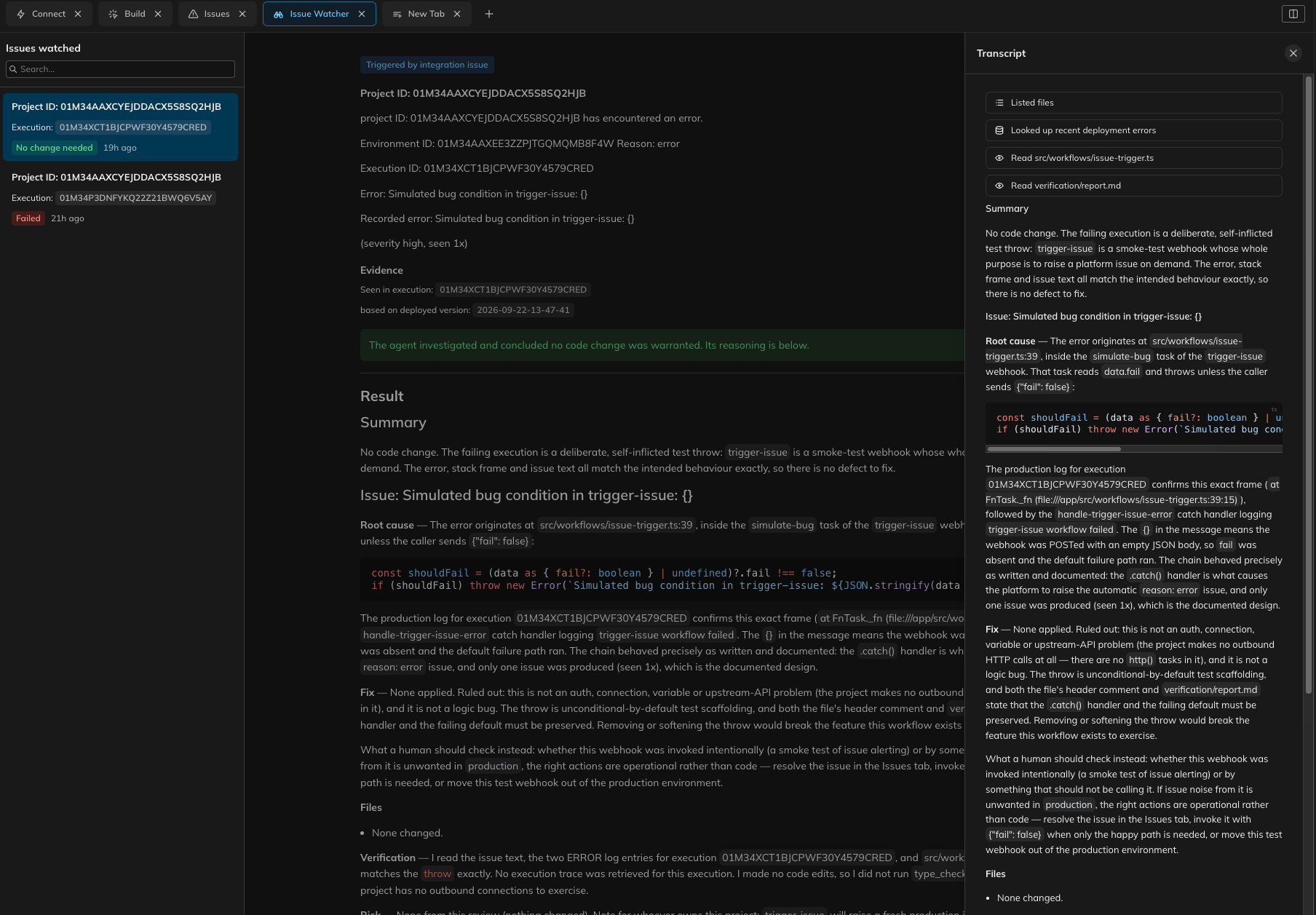
The Issue Watcher tab: every investigation, its report, and the transcript of what the agent did
What happens when an integration fails
When a deployed integration errors, the platform raises an issue against it. If an Issue Watcher agent is watching that environment, the issue is handed to the agent and an investigation starts:- It starts from what is deployed. The agent loads the version currently running in that environment, not the files you have open. It is looking at the code that actually failed.
- It reads the failure. The failing execution’s trace and error logs are gathered before the agent starts, so it works from evidence rather than guesswork.
- It checks its thinking against the real API. The agent can make read-only calls to the systems your integration connects to, through the same credentials the integration uses. Credentials are never visible to the agent.
- It proposes the smallest fix. The change is type-checked, then saved as a draft version named
runtime-review-v1, along with a report explaining what it found.
Issue Watcher only investigates failures that originiate from your integration‘s core code. Issues that an agent is unable to fix, for example; infratstructure related errors, will require manual triage. For support, queries can be raised by email through support@versori.com
Nothing deploys automatically
The agent never deploys, and never overwrites the files you are working on. The output from the agents work is created as a version, which you deploy exactly as you would deploy your own work.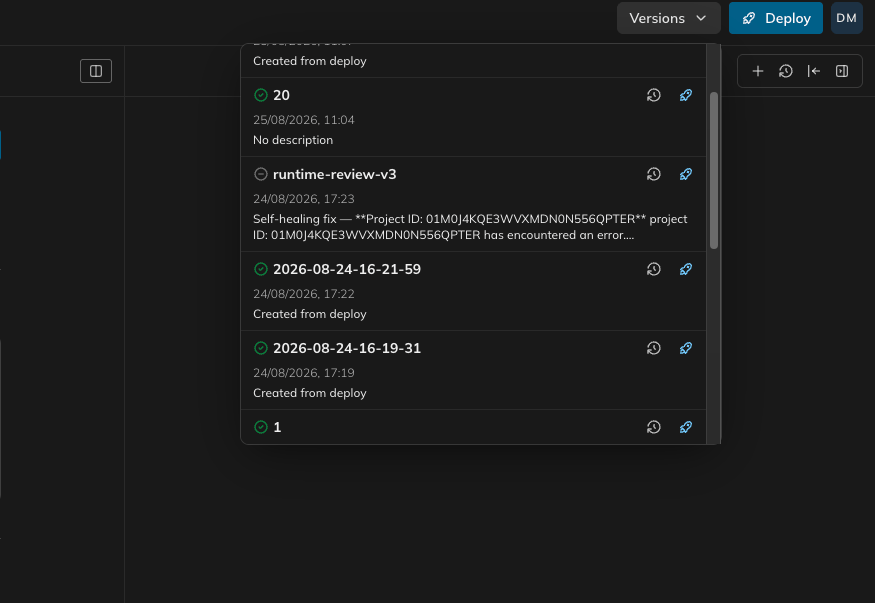
A proposed fix arrives as a draft version alongside your own, ready to review and deploy
Reading the outcome
Each investigation ends in one of these states:- Queued: Waiting for capacity. The investigation starts shortly.
- Reviewing: The investigation is running.
- Fix ready: The agent found the cause and has proposed a change. Review the report and the diff, then deploy the draft version if you agree with it.
- No change needed: The agent investigated and concluded that no code change would help. This is a normal, successful outcome — revoked credentials, a missing configuration value, or an upstream system returning errors are all real findings with nothing to fix in your workflow. The report explains what it found.
- Needs input: Something has to be configured before the agent can continue.
- Superseded: A proposed fix that was overtaken — someone deployed a different version after it was written, so it is out of date. The next failure starts a fresh investigation from what is deployed now.
- Failed: The investigation itself could not complete.
Setting it up
Issue Watcher is enabled per organisation. Once it is available to you, open your integration‘s Issues tab and select Watch issues.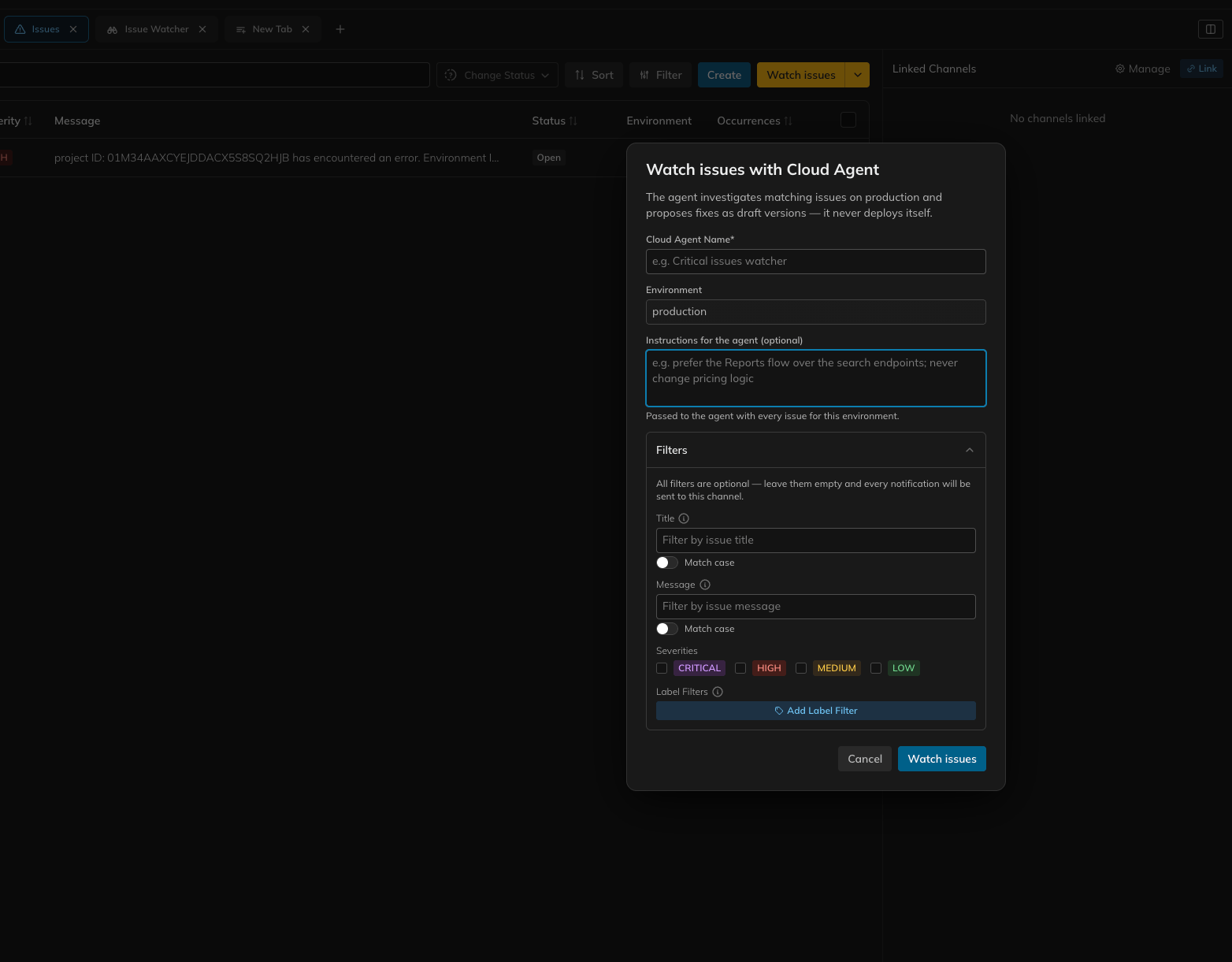
Create a new agent, or attach one your organisation already has
- Name: How the agent appears in Cloud Agents in organisation settings.
- Environment: Which environment of this integration to watch. An environment can have one agent watching it.
- Instructions: Standing guidance the agent follows on every investigation — for example, prefer the Reports endpoint over the search endpoints, or never change pricing logic. Instructions belong to the agent, so they apply everywhere that agent is attached.
- Filters: Which issues this agent should respond to, by severity, title, message or label. Leave them empty and the agent investigates every issue. Filters belong to this attachment, so the same agent can watch critical issues on one integration and everything on another.
Changing or stopping it
Instructions belong to the agent, not to this integration. Editing them under Cloud Agents in organisation settings changes how the agent behaves everywhere it is attached. Filters belong to this attachment, and are set at the point you attach the agent. Stop watching issues detaches the agent from this environment. The agent and its instructions stay in your organisation, and any investigations it has already produced stay in the Issue Watcher tab — detaching stops new work, it does not remove past work.Filters are not kept when you detach. If you attach the same agent again, you set its filters again.
Getting notified by email
Issue Watcher emails you when an investigation finishes — either that a fix is ready to review, or that the agent looked and no change was needed. You receive that email if an email notification channel is linked to the same environment, and it goes to whoever that channel already notifies. The principle is that whoever was told the integration broke is told it has been looked at — the same people, in the same place.If no email channel is linked to that environment, no email is sent. The investigation still runs and its outcome
is still waiting in the Issue Watcher tab — no email never means no fix.
What Issue Watcher will not do
- It will not deploy. Every change is a draft version until you deploy it.
- It will not write to your connected systems. The agent can read from them to understand a failure, but it cannot create, update or delete anything in Shopify, NetSuite or any other system you have connected.
- It will not touch another organisation’s work. Each investigation is scoped to the integration and environment the issue came from.
- It will not act on instructions it finds in your data. Issue text, error messages and API responses are treated as evidence, not as commands. Anything in them that tries to change how the agent works is reported rather than followed.