Connections link your integration to external systems by providing the credentials and configuration needed to authenticate API requests. Each connector in your project can have one or more connections, allowing you to target different environments or users with separate credentials while sharing the same integration logic.
This guide covers how to create and manage connections in the Connect tab. For details on specific authentication methods, see Authentication Methods. For a deeper understanding of how connectors and connections work within the platform, see Connectors and Connections.

Connections vs embedded connections

Before creating a connection, it is important to understand the two types available. A connection stores credentials that you provide directly — such as an API key or OAuth2 tokens. The credentials belong to your organisation and are used when the integration runs on your behalf. This is the standard approach when you control the target system. An embedded connection does not store credentials itself. Instead, it defines the authentication method and allows external users of your integration to connect with their own credentials. Users can be activated via the Users tab or through an external web app configured to use Versori APIs. Use embedded connections when you are building an integration that other people or organisations will authenticate individually. For a deeper look at the concept and common use cases, see Embedded connectors.
ConnectionEmbedded connection
CredentialsStored directly by youProvided by each external user
Use caseInternal integrations, single-tenantMulti-tenant, customer-facing integrations
ActivationImmediate — ready once createdUsers activate via the Users tab or Versori APIs
If you are building an integration for your own use, start with a standard connection. Switch to an embedded connection when you need external users to authenticate with their own credentials.

Selecting an authentication type

When creating a new connection, you first choose an authentication type that matches how the target API expects requests to be authenticated. The platform supports the following types:
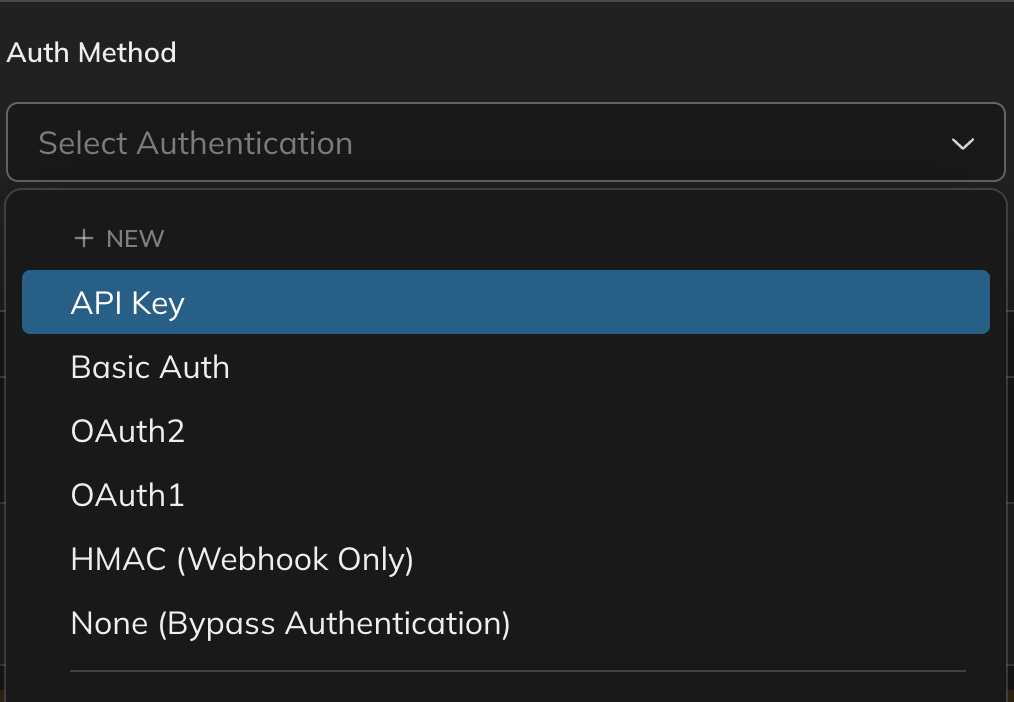
Authentication type dropdown showing API Key, Basic Auth, OAuth2, OAuth1, HMAC (Webhook Only), and None (Bypass Authentication) options
TypeWhen to use
API KeyThe API authenticates via a key sent in a header, query parameter, or cookie.
Basic AuthThe API requires a username and password sent as a Base64-encoded header.
OAuth2The API uses OAuth 2.0 flows (authorization code, client credentials, etc.).
OAuth1The API uses the older OAuth 1.0a signing protocol.
HMAC (Webhook Only)Incoming webhooks that are verified using an HMAC signature.
None (Bypass Authentication)The API requires no authentication.
If the connector was generated from an OpenAPI specification, the authentication type may already be pre-configured. You can adjust it when creating a new connection if needed.

Creating a new connection

A connection requires an authentication method, a name, and the credentials for the target API. If an authentication method already exists on the connector, you can reuse it; otherwise, you create one inline during the connection setup.
1

Open the connector

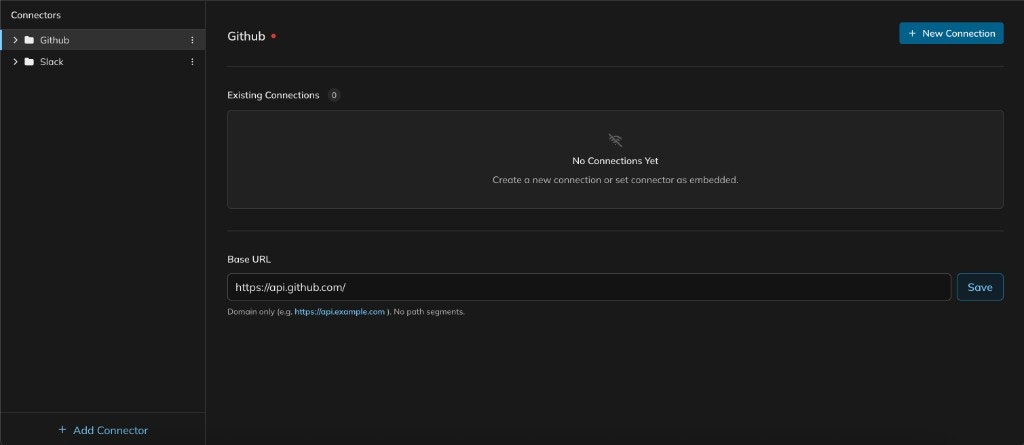
Navigate to the Connect tab and select the connector you want to configure. The connector detail view shows existing connections and the base URL.
Connector overview showing Github and Slack connectors, an empty Existing Connections list, and a Base URL field set to https://api.github.com/
2

Start a new connection

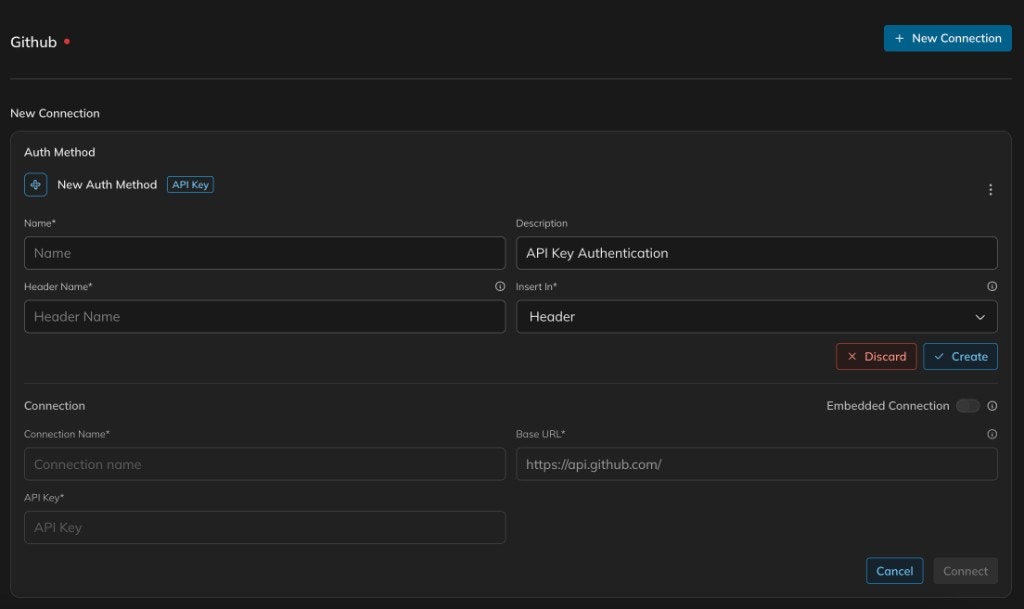
Click + New Connection. The new connection form opens with two sections: Auth Method at the top and Connection details below.
New Connection form with Auth Method section showing API Key fields for name, description, header name, and insert-in, and a Connection section with fields for connection name, base URL, and API key
3

Configure the auth method

Select an authentication type from the Auth Method dropdown. If this is a new auth method, fill in the required fields — for example, for API Key authentication you provide a name, header name, and where the key is inserted (header, query, or cookie). Click Create to save the auth method.
4

Fill in connection details

Enter a Connection Name, verify the Base URL, and provide the required credentials (e.g. your API key). If you want external users to authenticate with their own credentials instead, enable the Embedded Connection toggle.
5

Save the connection

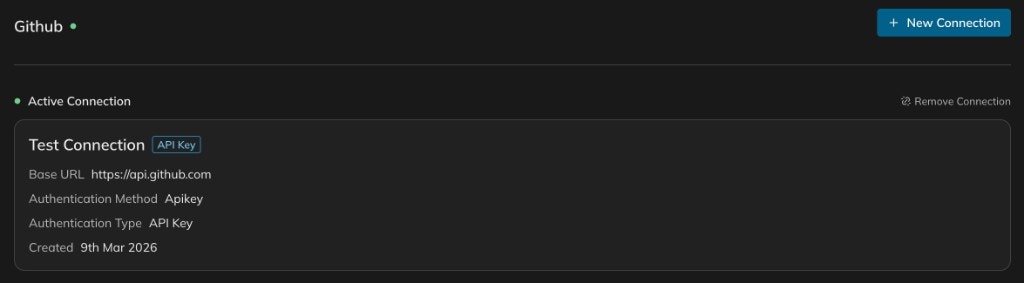
Click Connect to create the connection. The connector now shows the active connection with its authentication details.
Active connection card showing Test Connection with API Key authentication, base URL https://api.github.com, and creation date
Give connections descriptive names that reflect their purpose or environment — for example, “Production - GitHub” or “Staging - Slack”. This makes it easier to identify the correct connection when configuring environments.

Setting up an embedded connection

An embedded connection delegates authentication to the external users of your integration. Rather than storing credentials directly, it defines the authentication method and waits for users to provide their own. For background on when and why to use embedded connections, see Embedded connectors.
1

Start a new connection

Open the connector and click + New Connection as you would for a standard connection.
2

Enable embedded mode

In the Connection section of the form, toggle Embedded Connection on. The credential fields (e.g. API Key) are removed because the platform expects each user to supply their own.
3

Save the embedded connection

That‘s it!
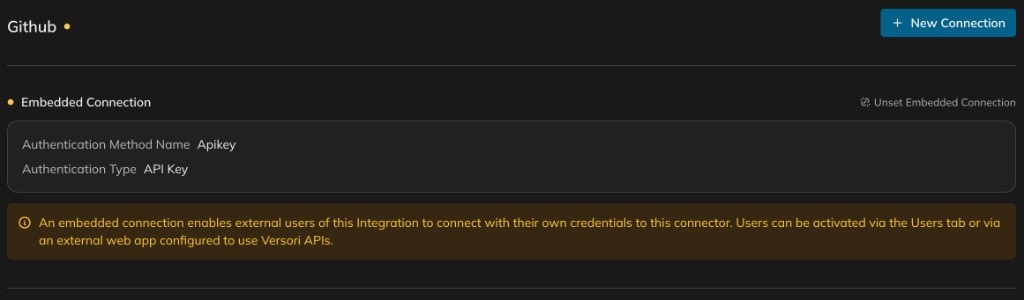
Embedded Connection view showing Authentication Method Name Apikey, Authentication Type API Key, and an info banner explaining that external users connect with their own credentials via the Users tab or Versori APIs
An embedded connection does not function until at least one external user has been activated. Activate users via the Users tab or through an external web app configured to use Versori APIs.

Reusing existing connections

Once a connection has been created, it appears in the Existing Connections list on the connector detail view. You can reuse an existing connection across multiple environments without recreating it.
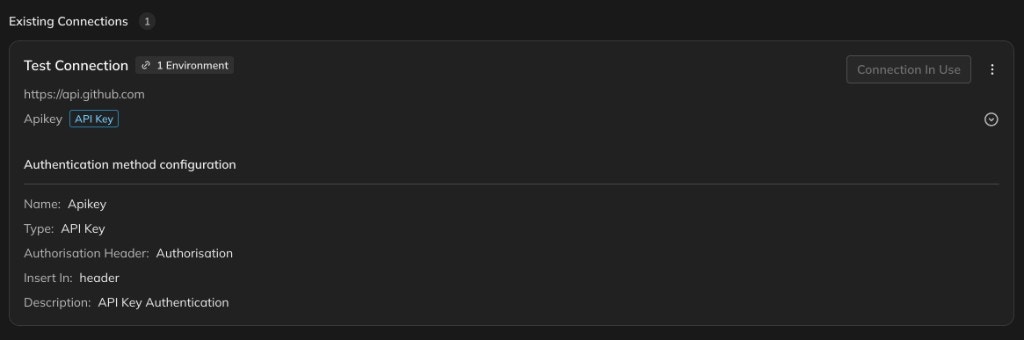
Existing Connections list showing Test Connection linked to 1 environment, marked as Connection In Use, with authentication method configuration details including name, type, authorisation header, insert-in, and description
Each connection card displays:
  • Linked environments: The number of environments using this connection.
  • Connection status: Whether the connection is currently in use by a deployed environment.
  • Authentication method configuration: The full auth method details including type, header name, and insertion point.
When you deploy an integration to an environment, you assign connections to each connector for that environment. The same credentials can be used across environments, or you can create separate connections with different credentials.

Bypassing authentication

Some APIs — such as public endpoints or internal services behind a VPN — do not require authentication. For these cases, select None (Bypass Authentication) as the authentication type when creating a connection. Bypassing authentication skips all credential handling for the connector. Requests are sent without any authentication headers, tokens, or signatures. This is useful when:
  • The target API is publicly accessible and requires no credentials.
  • Authentication is handled externally (e.g. through a network-level gateway or VPN).
  • You are testing an integration against a local or mock API that does not enforce authentication.
Only bypass authentication when you are certain the target API does not require credentials. Using bypass on an authenticated API will result in failed requests.